
Written by Richard Zehr
BBA, CAIB, President, Zehr Insurance
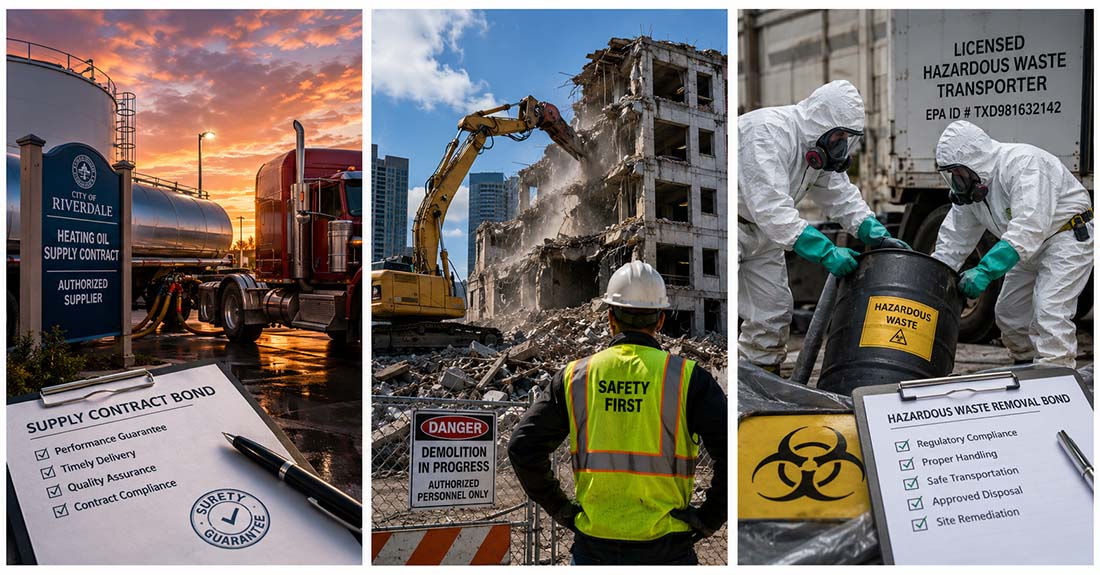
Within the surety segment of the insurance industry, some bonds are more common than others. Bid bonds, performance bonds, and payment bonds. But every so often a broker gets a call that doesn’t fit neatly into that box such as a municipality needs a bond for fuel oil supply, a demolition contractor needs bonding for a building teardown, or a client’s design/build project needs a completion guarantee that doesn’t look anything like a standard construction bond.
These are the bonds that separate the surety underwriters who really know their craft from the ones who just process paperwork. Let’s walk through a handful of these situations, what underwriters are worried about, and why the risk profile shifts so much from a typical construction bond.
Supply Contract Bonds: Fuel Oil, Food Service, Trash Removal
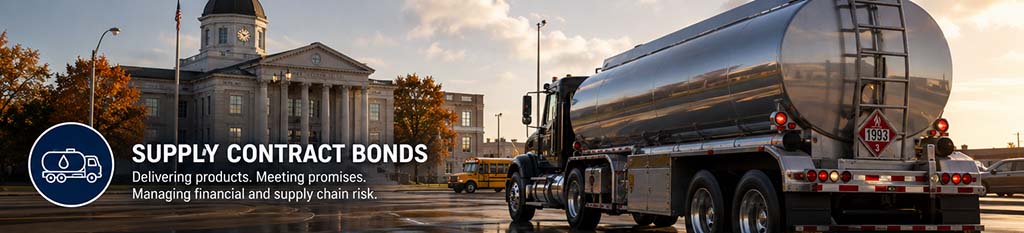
Supply bonds guarantee that a vendor will deliver goods or services under a contract. Some examples would include a municipality’s heating oil supplier, a school board’s cafeteria food service provider, or a city’s waste hauler. On the surface these look simple. No structures being built, no complex means and methods, no multi-trade coordination. So why do underwriters still sweat these?
The underwriting considerations come down to a few core things:
- Commodity price volatility. Fuel oil is the classic example. A supplier locks in a price to deliver oil to a school board for a heating season, and then crude prices spike. This may sound familiar. Suddenly the contract that looked profitable is underwater, and the temptation (or financial necessity) to default becomes very real. Underwriters need to understand whether the contract has price escalation clauses, how the supplier hedges fuel purchases, and what their margin cushion looks like.
- Working capital and cash flow. Supply contracts often require the vendor to carry significant inventory or extend credit terms before getting paid. A food service company supplying a school district needs enough working capital to buy groceries for months before invoicing. If the company’s balance sheet is thin, that’s a red flag.
- Supplier concentration risk. Where is the fuel, food, or hauling capacity actually coming from? If the bonded principal is entirely dependent on a single upstream supplier or a handful of trucks, one disruption (a refinery outage, a truck breakdown, a labor dispute) can tank performance.
- Contract duration and renewal risk. Many of these are multi-year contracts. Underwriters look hard at whether pricing is fixed for the full term or adjusts annually, because a three-year fixed-price fuel contract signed in a low-price environment is a very different risk than one with quarterly price resets.
Financial factors underwriters focus on current ratio and quick ratio (can the company weather a cash crunch), historical gross margins on similar contracts, and (critically for fuel and commodity suppliers) hedging strategy and exposure to spot market pricing.
The surety’s biggest fear here isn’t shoddy workmanship, it’s a financial squeeze forcing default. This occurs when a supplier who simply can’t afford to keep delivering at the contracted price and walks away, leaving the obligee (the municipality, the school board) scrambling for a replacement supplier, often at a much higher emergency rate.
Demolition Contract Bonds
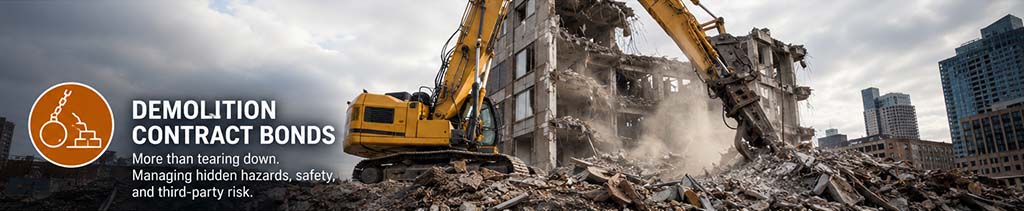
Demolition looks like construction in reverse, but the risk profile is genuinely different, and in some ways more worrying for a surety.
Key underwriting considerations:
- Site conditions and pre-existing hazards. What’s actually in that building? Older structures almost always carry the risk of asbestos, lead paint, or PCBs, which turns a “simple” teardown into an environmental remediation project with a completely different cost structure and regulatory burden.
- Structural collapse and adjacent property risk. Demolition near occupied buildings, underground utilities, or in dense urban environments carries serious third-party liability exposure. A miscalculated implosion or an unstable partial demo can damage neighboring structures.
- Contractor experience with the specific demolition method. Mechanical demolition, implosion, and deconstruction (selective salvage) all require very different expertise, equipment, and safety protocols. Underwriters want to see a track record with the specific method proposed, not just general demolition experience.
- Disposal and landfill logistics. Where is the debris going, and does the contractor have secured, compliant disposal arrangements? Illegal dumping or disposal cost overruns are a real source of claims.
- Environmental and safety compliance history. OSHA/health and safety violations, prior environmental fines, and incomplete abatement work on past jobs are all major red flags.
Financial factors: equipment ownership vs. leasing (heavily leveraged equipment fleets increase risk), bonding capacity relative to project size, and the contractor’s history of change orders because demolition projects are notorious for scope creep once a wall comes down and something unexpected is behind it.
The surety’s major concern with demolition is unforeseen conditions turning a fixed-price job into a money pit, combined with third-party bodily injury or property damage exposure that can dwarf the original contract value.
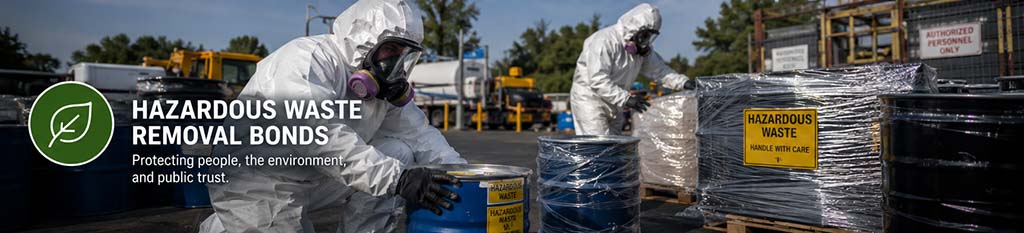
Hazardous Waste Removal Bonds
This is where things get genuinely specialized, and where underwriters often lean on outside environmental expertise before they’ll even quote.
Underwriting considerations:
- Licensing and certification. Hazardous waste haulers and remediation contractors need specific federal and provincial/state licensing. An underwriter’s first move is confirming the contractor holds every required certification. These certifications are not just “an environmental license” generally, but the specific one for the waste class involved (asbestos, PCBs, contaminated soil, biomedical waste, etc.).
- Chain of custody and disposal site legitimacy. Where does the waste end up? Underwriters want confirmation the contractor uses licensed, permitted disposal facilities. If waste ends up somewhere it shouldn’t, the liability doesn’t stop at the contractor.
- Long-tail liability. Environmental claims can surface years after a project completes. This is fundamentally different from a construction defect claim with a defined limitation period; environmental contamination discovered a decade later can still trigger claims against the original remediation contractor.
- Regulatory environment. This is a heavily regulated space, and underwriters need to understand which regime applies. Federally, that’s the Canadian Environmental Protection Act (CEPA), which governs toxic substances and interprovincial/international movement of hazardous waste. In Ontario specifically, the key pieces are the Environmental Protection Act (EPA), O. Reg 347 (General – Waste Management), and the Environmental Activity and Sector Registry (EASR) requirements administered by the Ministry of the Environment, Conservation and Parks (MECP). Contractors handling hazardous waste also need to be registered generators/carriers under Ontario’s hazardous waste manifest system, which tracks waste from generation through to final disposal. A contractor working across provinces needs to demonstrate compliance with each province’s specific regime, since waste management rules aren’t harmonized nationally.
- Insurance program alignment. Underwriters check that the contractor’s pollution liability (environmental impairment liability) insurance is adequate and current. A surety bond and a pollution liability policy need to work together, not leave gaps.
Financial factors: because environmental cleanup costs can balloon dramatically if contamination is worse than initially scoped, underwriters want to see financial reserves or strong access to capital, not just enough working capital for the contract as bid.
The surety’s biggest concern is the open-ended nature of environmental liability. A job that looks like a $200,000 contract can turn into a multi-million-dollar cleanup if contamination is more extensive than the original site assessment indicated, and the surety could be on the hook to complete that work.
Specialized Construction Arrangements
Turn-Key Projects
In a turn-key arrangement, the contractor delivers a fully finished, ready-to-operate facility where the owner isn’t managing multiple trades or phases. That convenience for the owner means the contractor is absorbing enormous scope and coordination risk.
Underwriters focus on whether the contractor has genuinely managed a full turn-key delivery before (design, procurement, construction, and commissioning) versus just acting as a general contractor on a traditional design-bid-build job. The surety’s concern is scope creep and coordination failure with so many moving pieces under one contractor’s responsibility, a breakdown anywhere in the chain (design delay, equipment procurement issue, subcontractor default) becomes the bonded principal’s problem, and by extension, the surety’s.
Design/Build Contracts
Design/build combines design and construction responsibility in a single contract, which shifts risk in a way traditional bonding wasn’t originally built for.
Key underwriting questions: Does the contractor have in-house design capability or a genuinely reliable design partner? What happens if a design error causes a construction defect and who’s responsible, and is that captured properly in the bond wording? Underwriters need to dig into the contractor’s history of design-related claims, not just construction claims, because in this model the two are inseparable.
The surety’s major concern is liability blending and untangling whether a failure originated in design or construction becomes much harder, and design errors can be far more expensive to fix after the fact than construction errors caught early.
Construction Management (CM) Arrangements
Under a CM-at-risk model, the construction manager guarantees a maximum price (GMP) while coordinating multiple trade contractors, essentially acting as both advisor and guarantor.
Underwriters look closely at the CM’s subcontractor default history (since the CM is exposed to every sub they hire), the reasonableness of the GMP relative to actual scope, and the CM’s track record managing multi-trade coordination without cost overruns. The surety’s concern is that the CM is guaranteeing the performance of parties they don’t fully control and a default by any one subcontractor can flow uphill and threaten the CM’s ability to hit the guaranteed price.
Efficiency Guarantees
These show up most often in energy retrofit and performance contracting work. A contractor guarantees a building will achieve a specific level of energy savings after upgrades. This is a genuinely unusual bond because the “performance” being guaranteed isn’t construction completion, it’s an outcome that depends partly on factors outside the contractor’s control (occupant behavior, weather, how the building is used).
Underwriters need to understand the measurement and verification (M&V) methodology being used, whether savings projections are based on solid engineering models or optimistic sales assumptions, and what happens contractually if savings fall short. Is there a cure period, a payment adjustment, or a hard default trigger? The surety’s major concern is that efficiency guarantees involve real uncertainty even when the contractor does everything right, which is a fundamentally different risk than “did they build the thing correctly.”
The Common Thread
Across all of these, the pattern underwriters are watching for is the same: how much of the risk is within the contractor’s control, and how much depends on external forces. The further a bond gets from “we built exactly what was specified, on time, for the agreed price,” the more underwriting has to lean on financial strength, specialized experience, regulatory compliance, and often outside expert opinion before a surety is comfortable putting its name behind the obligation.
About Zehr Insurance
At Zehr Insurance, we work with contractors to free up cashflow and support project completion through surety bonds. Bond facilities are to limited to only large construction firms. If your company is financially strong and you are interested in exploring bonding options, please contact our office.
Call Zehr Insurance brokers and see if we can help you with your insurance needs.