

Written by Richard Zehr
BBA, CAIB, President, Zehr Insurance
Your Financial Story Matters
When performing bonded projects, it is likely that a labour and materials payment bond will be required. it is important to understand what happens when a claim lands against the L&M Bond and what the contactor’s obligations are through the claims process.
What triggers a L&M Bond claim, what the surety needs from you, what they can do to remedy the situation, and why all of it ultimately protects the project you’ve been hired to finish.
What is a labour and materials bond and who can make a claim?
A labour and materials (L&M) Payment Bond is a three-party agreement. You’re the principal. Your bonding company is the surety. The project owner is the obligee which is the named beneficiary of the bond’s protection.
But the people who use the bond are your downstream parties: subcontractors you hire, material suppliers, equipment lessors, and workers who provide labour on site. If any of them haven’t been paid for work properly done under your contract, they have a claim right under the bond.
Think of the L&M Bond as a payment guarantee that runs through the general contactors’ whole supply chain. The GC at the top. Everyone below you who works for or supplies materials to the project is protected by the L&M Bond.
How does a claim get triggered?
A claim under an L&M Bond is triggered when four things are true:
- A subcontractor, supplier, or worker provided labour or materials to move the project towards completion.
- They have not been paid for that work or materials.
- They file written notice of their claim with the surety within the timeframe set out in the project contract.
- The claim falls within the bond’s coverage, meaning the work was actually within the scope of your prime contract.
The most common scenarios that trigger claims are:
A subcontractor you haven’t paid because of a cash flow squeeze on your end, a payment dispute, or a deficiency holdback that has gone unresolved. A material supplier whose invoices have aged out without payment because of an upstream dispute with the owner. A subtrade’s worker is filing a wage claim when that subcontractor can’t make payroll. A cascading payment failure where the owner has withheld a progress payment from you and your trades have stopped receiving money as a result.
Your co-operation obligations when a claim is filed
Once a claim is made against your bond, the surety becomes legally active and you have firm obligations to assist them. These obligations aren’t optional and they’re embedded in your indemnity agreement with the surety and in the bond itself.
Produce your records promptly. The surety needs your subcontracts, purchase orders, change orders, and payment ledgers for every trade and supplier on the project. Incomplete records slow everything down and can put you in breach of your co-operation duty.
Make your people available. Your project manager, site supervisor, and accounting staff may be needed for interviews. Restricting access to these individuals is a breach of your obligations and signals to the surety that something is wrong.
Disclose your defences immediately. If you believe the claim is invalid and the work performed by subs is deficient, the quantities are overstated, the claimant is outside the bond’s coverage, or amounts have already been paid you should tell the surety right away, in writing and with documentation. The surety can fight these defences for you, but only if you give them sufficient information.
Don’t take actions that tie the surety’s hands. You cannot settle directly with a claimant in a way that depletes project funds and leaves the surety exposed. You cannot make admissions or sign side agreements that bind the surety without their consent. Any payment you make to a claimant should be co-ordinated with the surety so it’s properly credited against the bond.

What can the surety actually do about a claim?
Once the surety has investigated the claim and confirmed it’s valid, they have several tools available. Which one they use depends on the facts, the project stage, and the financial position of the parties.
Pay the claimant directly. The simplest resolution is the surety pays the claimant what’s owed, up to the bond’s penal sum. This extinguishes the claim but triggers their right to recover every dollar from you through your indemnity agreement.
Negotiate a settlement. Where the amount is disputed or the claimant has been overpaid relative to the work actually completed, the surety may settle at a reduced figure. You may be brought into these negotiations, and the settlement will count against the bond’s limit.
Assert your defences on your behalf. Where you have a legitimate legal position against the claimant such as deficient work, improper notice, amounts already paid, or claim outside scope, the surety can advance those defences to reduce or defeat the claim entirely. This is why early and detailed disclosure matters so much.
Arrange for completion of abandoned work. If a subcontractor has walked off the job because they weren’t paid, the surety may arrange and pay for a replacement subcontractor to finish that scope, keeping the project moving.
Exercise subrogation rights. Once the surety pays, they step into the shoes of the claimant and can pursue recovery from you or from any other party in the chain responsible for the non-payment. This right exists on top of the contractual indemnity they already hold.
One important cap: the surety’s obligations are limited to the bond’s penal sum. A typical L&M bond is written at 50% of the contract price, though 100% bonds are required on many Ontario public projects. Claims that exceed the penal sum leave claimants to pursue lien remedies and direct claims against you personally.
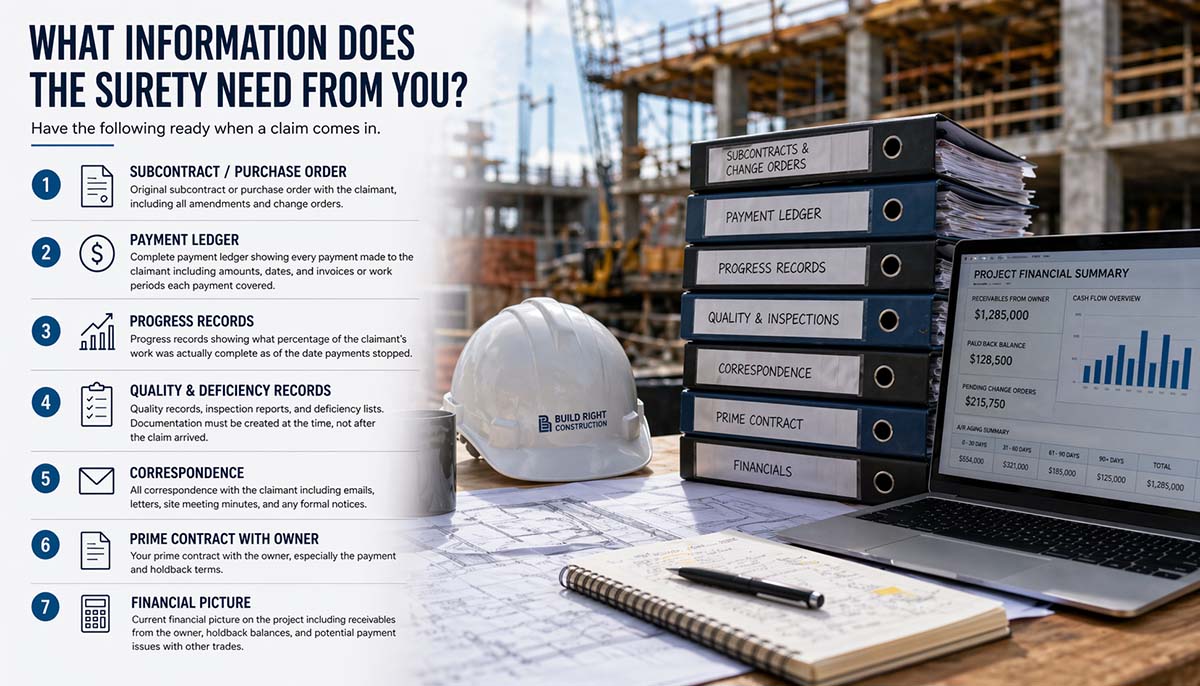
What information does the surety need from you?
The quality of your claim outcome is almost entirely determined by how quickly and completely you deliver information. When a claim comes in, have the following ready:
- The original subcontract or purchase order with the claimant, including all amendments and change orders. This establishes the baseline of what was contracted and what was owed.
- A complete payment ledger showing every payment made to the claimant including amounts, dates, and which invoices or work periods each payment covered. This allows the surety to verify the net balance outstanding.
- Progress records showing what percentage of the claimant’s work was actually complete as of the date payments stopped. If the claimant is claiming for work not yet performed, this is your primary defence.
- Quality records, inspection reports, and deficiency lists. If you’re withholding payment due to deficient work, you need documentation that was created at the time and not assembled after the claim arrived.
- All correspondence with the claimant. This includes emails, letters, site meeting minutes, and any formal notices you gave about performance or payment withholding.
- Your prime contract with the owner, especially the payment and holdback terms. The surety needs to understand the full payment chain and whether owner-level disputes are contributing to the claim.
- Your current financial picture on the project including receivables from the owner, holdback balances, and whether you anticipate further payment problems with other trades.
How all of this protects the project owner and why that matters to you
It might seem counterintuitive that a bond designed to protect your subtrades ultimately serves the project owner’s interests. But that’s exactly how the system is designed.
The owner’s fundamental goal is a finished project with no financial encumbrances on their property. Under Ontario’s Construction Act, every unpaid subcontractor and supplier has the right to register a lien against the project and the owner’s land. If your supply chain goes unpaid, the owner can face lien registrations that stop construction, cloud title to their property, and force them to pay twice. Once to you under the contract, and again to your unpaid trades to clear the liens.
The L&M bond eliminates that risk. When the surety pays your claimants, liens are discharged, the supply chain is made whole, and the project continues toward completion. Every step the surety takes from investigating the claim, negotiating a settlement, asserting your defences, and arranging for replacement trades is aimed at keeping the project moving for the owner.
This is the architecture of the whole contract surety system in Ontario. The bid bond gets the owner a committed contractor at a firm price. The performance bond gets the project finished if the contractor fails. The L&M bond keeps the supply chain paid, lien-free, and on schedule.
The contractors who understand their obligations during a claim and who engage the surety early, disclose fully, and stay organized will consistently see faster resolutions, lower claim costs, and stronger bonding relationships over time. The ones who don’t tend to find out the hard way how expensive non-co-operation can be.
About Zehr Insurance
At Zehr Insurance, we work with contractors to free up cashflow and support project completion through surety bonds. Bond facilities are to limited to only large construction firms. If your company is financially strong and you are interested in exploring bonding options, please contact our office.
Call Zehr Insurance brokers and see if we can help you with your insurance needs.